

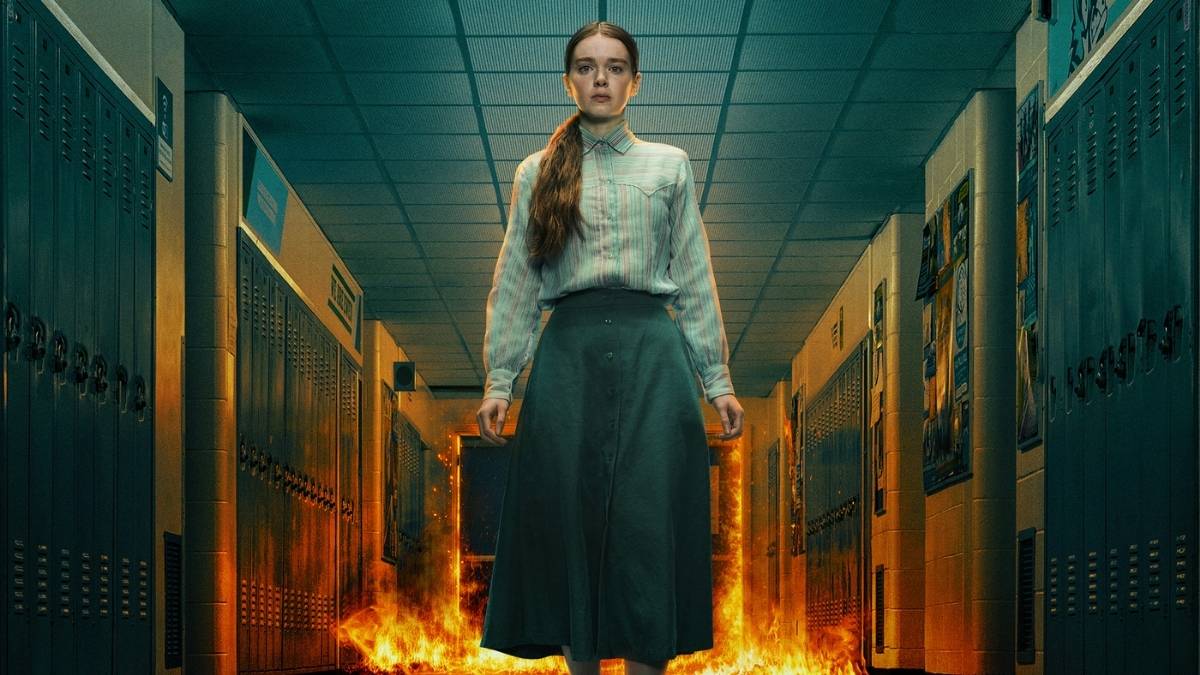

Carrie (2026) Review — This Isn’t the Carrie You Know, and That’s Not a Bad Thing
★★★½ out of ★★★★★

Let’s get something out of the way right at the start of this Carrie (2026) review: this is not the Carrie you know.
And that’s not necessarily a bad thing.
Taking Stephen King’s relatively lean novel—and a story that has already been adapted for the screen multiple times—and stretching it into an eight-episode series was always going to require some serious expansion. Characters have to become more complicated. Relationships need room to breathe. The world surrounding Carrie White has to become considerably larger than the one we’ve previously seen.
The result is something that feels less like a traditional horror adaptation and more like a strange hybrid of thriller, drama, science fiction and, occasionally, horror.
And you know what? That’s okay.
Because underneath all of those changes, the themes that have always made Carrie resonate are still very much alive.
Alienation. Isolation. The pain of being different in a society that doesn’t particularly reward individuality—even when that difference is accompanied by intelligence, creativity or genuine sensitivity.
Carrie White remains the ultimate outsider. The difference is that the world around her has changed.
Bullying Has Evolved
Setting Carrie in the modern era means confronting something the original novel could never fully anticipate: bullying no longer ends when you leave school.
It follows you home. It lives on your phone. It gets recorded, shared, commented on, reposted and preserved.
The series dives heavily—and occasionally a little heavy-handedly—into social media and its destructive nature. But it also asks a more interesting question about responsibility.
Who is actually guilty when something terrible happens?
The person who started it? The person who shared it? The person who laughed? Or the people who simply watched it happen?
That idea has always existed somewhere inside the DNA of Carrie, but here it becomes one of the series’ central themes. Cruelty is no longer necessarily the product of a single bully. It becomes communal.
And sometimes passive participation can be nearly as destructive as active cruelty.
That makes this version of Carrie feel appropriately contemporary rather than simply updated for the sake of putting smartphones in everyone’s hands.
An Exceptional Ensemble
The biggest strength of the series is unquestionably its cast.
Summer H. Howell makes for a compelling Carrie White, but this is very deliberately an ensemble production, and there are stretches where the people surrounding Carrie become every bit as important as Carrie herself.
That creates one of the show’s biggest strengths—and occasionally one of its biggest problems.
Alison Thornton as Chris Hargensen is especially impressive. There are scenes where Thornton barely needs dialogue. A look, a hesitation or the slightest change in expression tells you everything happening underneath the surface. There are moments where she simply steals scenes with her eyes.
Siena Agudong is equally capable as Sue Snell, bringing a convincing complexity to a character who could easily have become little more than a narrative counterbalance to Chris.
Then there is Samantha Sloyan as Margaret White.
Margaret has traditionally been one of the easiest characters in Carrie to simply turn into a monster. Here, she is given considerably more dimension. She remains frightening, oppressive and deeply damaging, but the character is also more multifaceted than many previous screen incarnations have allowed her to be.
Michael Trucco’s John Hargensen is another character you absolutely love to hate whenever he appears.
And Matthew Lillard continues to demonstrate why seeing him turn up in practically anything these days is a welcome sight.
The problem with having this many interesting characters is that Carrie occasionally gets sidelined in her own story.
There are episodes and stretches where the interactions between supporting characters are so convincing—and so well written—that the central narrative temporarily fades into the background.
Sometimes that works. Sometimes it doesn’t.
Where’s Tommy?
One casualty of the expanded ensemble is Tommy Ross.
Tommy has always functioned as something of a moral barometer in Carrie. His presence matters because he represents something Carrie rarely encounters: decency without an obvious ulterior motive.
Here, he feels comparatively underdeveloped. And the less we see of Tommy, the more noticeable his absence becomes.
That’s especially unfortunate because the longer format theoretically provides more opportunity than ever to explore exactly why Tommy matters. Instead, while numerous secondary characters become considerably richer, Tommy occasionally feels like someone the story simply remembers it needs.
That imbalance becomes particularly noticeable as the series begins repositioning familiar pieces of the Carrie story.
A Different Carrie
Purists are probably going to have some issues here. I’ll admit that the purist in me occasionally did.
Certain beats feel changed simply for the sake of changing them. By the time the story approaches events we know are coming, Carrie’s social position has shifted considerably from where we traditionally expect it to be.
We’ve seen adaptations experiment with that idea before, but experiencing that transformation across eight episodes makes it hit differently.
Whether it works will probably depend heavily on what you want from a Carrie adaptation.
If you want King’s novel meticulously reconstructed for television, this isn’t it.
But we’ve already seen Carrie. Several times.
So I’m willing to let the purist in me sit in the back seat for a while if it means getting eight episodes that attempt to visualize this story in ways we haven’t seen before.
And there are some genuinely interesting ideas here.
Is Carrie Building a King-Verse?
Perhaps the most surprising element of the series is just how expansive this world begins to feel.
This does not feel like Carrie encapsulated into eight episodes. It feels like a first season.
More importantly, it occasionally feels as though Mike Flanagan may be using Carrie as a doorway into something considerably larger.
There are Easter eggs and references to other Stephen King properties that I genuinely didn’t expect. The deeper the series gets into psychic abilities, organizations and people with their own agendas, the harder it becomes not to start connecting some dots.
Is there a little Firestarter DNA lurking here? Could some of this eventually intersect with The Institute? Are we beginning to see the foundation for something connecting King’s numerous psychic children, mysterious agencies and supernatural phenomena?
Maybe. But the possibility is fascinating.
And considering Flanagan’s long-discussed ambitions surrounding The Dark Tower, it’s difficult not to wonder whether Carrie could ultimately represent one small corner of a much larger King universe.
If that’s the plan, somebody needs to get Mike Flanagan’s ass in gear, because I’m ready.
The Horror Isn’t Always Supernatural
Despite Carrie’s abilities, some of the most effective horror here isn’t supernatural at all. It’s social.
It’s watching cruelty spread because everyone has a camera. It’s watching people make terrible decisions for reasons that aren’t entirely terrible. It’s realizing that practically everyone’s morality exists on a sliding scale.
That may actually be the smartest thing this adaptation does.
Characters who traditionally would have been straightforward villains are allowed moments of vulnerability. People we sympathize with make selfish choices. Characters we despise occasionally reveal something recognizably human underneath.
There are moments when you find yourself sympathizing with people you absolutely wouldn’t have sympathized with in previous versions of Carrie.
Nothing is quite as black and white this time around. And that makes the inevitable consequences considerably more complicated.
Final Verdict
I’m a huge Stephen King fan, and perhaps the best compliment I can give the series is this: It never really feels un-King.
There are moments, however, when it definitely feels a little un-Carrie. That’s an important distinction.
The performances are excellent. The younger cast in particular is remarkably strong, and if I were rating the series solely on performances, we’d probably be looking at four-and-a-half stars.
But some familiar beats have been altered without necessarily becoming stronger in the process. Tommy is underutilized. Carrie herself occasionally disappears behind an ensemble that becomes almost too interesting.
And the expansion of this universe means the story sometimes feels more interested in where it’s going than where it currently is.
Still, I’d rather see someone take a legitimate swing at Carrie than simply recreate the same movie again.
This is beefier. It’s meatier. It’s stranger. It’s more science fiction. It’s more socially conscious. And potentially, it’s much bigger than Carrie White herself.
Whether that larger world ultimately pays off remains to be seen. But for now?
Horror-Fix gives Carrie ★★★½ out of ★★★★★—with that rating occasionally threatening to creep toward four stars.
This isn’t the Carrie you know. Give it a chance anyway.