



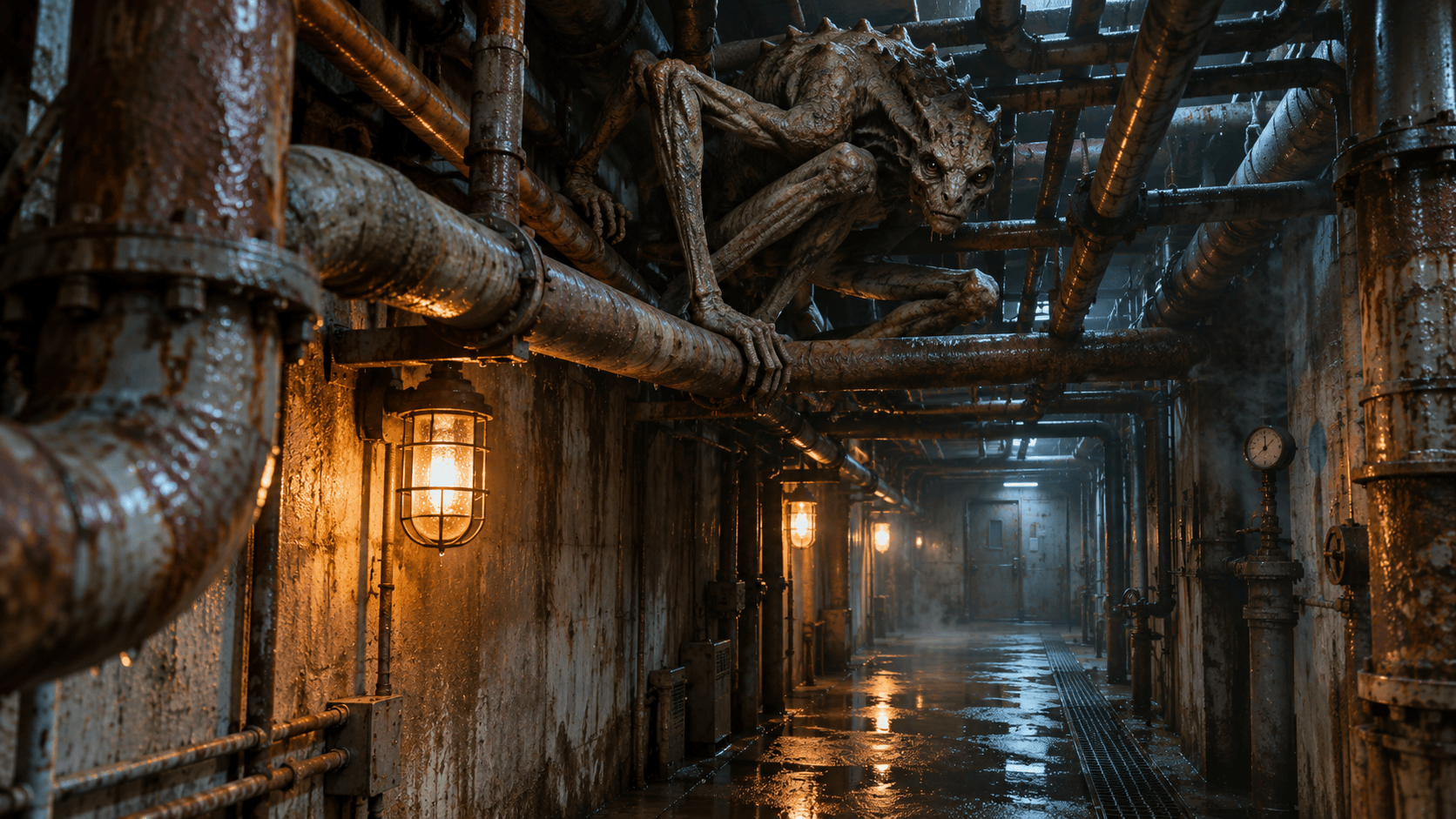
The Xenomorph made us afraid of the plumbing. The shark in Jaws made us afraid of water. When did we settle for monsters that only scare us while they’re on screen?
By Rory Jackson
The shark in Jaws made me suspicious of water I couldn’t see through. That’s an absurd amount of influence for a fish that spends most of the movie offscreen.
Now think about the last creature feature you watched. You probably remember whether you liked it. Can you draw the monster from memory? Can you describe how it moved? Hell, can you tell me what made it different from the thing in the last movie that came crawling out of a vent?
I don’t think the great horror movie monster is dead. I think we’ve gotten very good at making creatures that look dangerous and less interested in giving them habits, appetites and a place they make their own. A great monster doesn’t just give you something to look at. It changes what you look at when it’s gone.
A Great Monster Has a Way of Doing Things

The creature in Alien doesn’t simply hide in the dark. It looks like it belongs in the dark aboard the Nostromo. Ridley Scott gives us chains, pipes, condensation and machinery with enough ugly detail that the damn thing can be right in front of us without looking out of place. By the end, you don’t trust a bend in a pipe. The creature has changed the set without moving a single wall.
John Carpenter’s The Thing pulls the same trick with people. The creature can imitate the person you’d ordinarily turn to for help. That means the movie can build a whole stretch of suspense out of men looking across a room at one another. The blood test is frightening before anything happens because you understand exactly what an answer would mean for everyone sitting there.
Give a creature a behavior specific enough to recognize and you give the audience something to watch for. Give it eighteen rows of teeth and you’ve mostly given it a hell of a dental bill.
Stop Showing Me the Monster and Start Showing Me What It Does to People
Universal’s Frankenstein gives its creature a scene beside a lake with a little girl who isn’t afraid of him. They throw flowers into the water and watch them float. He makes a terrible mistake because he doesn’t understand what she does. The scene is hard to watch precisely because Boris Karloff lets you see the creature’s delight before you see the harm he causes.
That’s a scene only Frankenstein’s monster could have. Put the shark in it and you’ve got a considerably shorter movie.
Look at Gremlins from the other direction. Those little bastards don’t just attack Kingston Falls. They take over a bar and go to the movies. The town becomes their playground. You can imagine them getting into trouble even if the human cast never comes back. A lot of creature designs would make perfectly good action figures. The Gremlins seem like they’d steal the action figures and sell them back to you.
I miss that kind of personality more than I miss any particular era of monster makeup. A creature doesn’t have to talk or make jokes. It just has to do something that tells you who showed up.
Practical Effects Help. They Don’t Do the Thinking for You.
I’ll happily watch somebody spend four minutes turning into a werewolf in An American Werewolf in London. The reason I squirm isn’t just that Rick Baker’s effects hold up. It’s that David Naughton looks like a man who would give anything for his own body to stop doing what it’s doing. The bones changing shape are impressive. The pain is what makes the scene hard to sit through.
A practical monster can still be boring. Give a performer a gorgeous suit, then cut away every time they do something interesting, and you’ve paid somebody to sweat through a close-up of a doorframe. A digital creature can work beautifully when the filmmakers know how it moves through a room, what it weighs and how the people in that room should react to it.
What I don’t buy is the idea that a more elaborate creature automatically gives you a better scene. Show me a werewolf trying to get out of a shirt it no longer fits into. That tells me more about the transformation than another shot of the moon ever will.
The Good Ones Are Still Out There
The Ritual has a creature I remembered after I’d forgotten which of the hikers said what. Its outline looks wrong in stages. You see enough to think you’ve identified the animal, then notice something that makes you revise your answer. The forest matters just as much. It gives the creature somewhere to stand where not seeing it clearly is entirely your problem.
The creature in Nope works almost the other way around. It has a broad, readable shape, and Jordan Peele makes the characters learn how to share the landscape with it. Once you start to understand the relationship between looking and danger, a person standing in an open field can be more suspenseful than a creature filling the frame. There’s a reason to look away and an equally good reason to keep watching.
And The Host shows you its monster in daylight, in the middle of a crowd. So much for the rule that you should never show the creature early. Bong Joon Ho gets away with it because the scene isn’t a product reveal. It’s a public space falling apart faster than anyone can make sense of it. The monster has room to move, people have room to make mistakes and the river is never going to look like a pleasant place to spend the afternoon again.
Those movies disagree about how much to show and when to show it. What they share is a clear idea of what changes the instant the monster shows up.
Give Me a Reason to Keep Looking at the Water
I don’t need the next great horror movie monster to launch a franchise. I don’t need it to explain its ancestry or give me a second creature in the final shot so I know to come back in two years.
I need it to make one ordinary thing feel different. A cloud that hasn’t moved. A ceiling full of pipes. A friend who’s been gone just long enough.
That’s what the great ones leave behind. The movie ends, you turn off the television and your house goes back to making all the same noises it made before.
You’re the one listening differently.
