


Rating: 4.5/5 Stars ★★★★½
 There are a million things in this world that should absolutely terrify us. Things lurking in the deepest oceans, things buried beneath the earth, things that exist just beyond our understanding of the natural world. Yet, for some reason, horror seems perfectly content to keep returning to the same handful of monsters, masked killers, and haunted houses.
And then something like WhaleFall comes along and reminds us just how much untapped terror is out there.
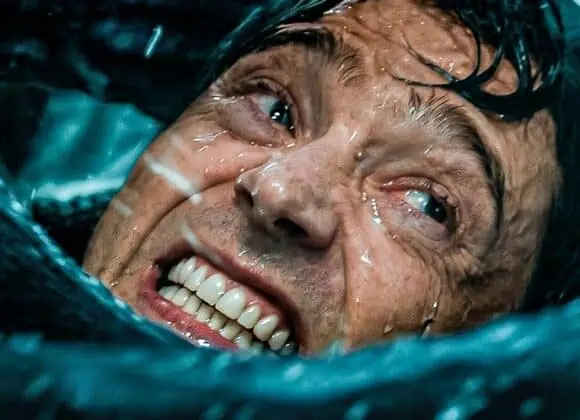
On the surface, WhaleFall is about a man being swallowed by a whale. That’s it. That’s the hook. And admittedly, it’s a pretty damn good one. But what makes this film so remarkable isn’t simply the horrifying predicament at its center. It’s that underneath all the suffocating dread, grotesque imagery, and primal terror lies something far more devastating.
WhaleFall is really about fathers and sons. It’s about the things we never say, the conversations we never have, and the terrible realization that sometimes we don’t truly understand the people closest to us until it’s too late.
And somehow, a movie about being swallowed by a whale manages to make that realization absolutely heartbreaking.
A Different Kind of Horror
There’s something almost antiquated about the premise of WhaleFall. The idea of a human being swallowed whole by a massive sea creature is practically as old as storytelling itself. From biblical tales to Pinocchio, we’ve been fascinated by the idea of disappearing into the belly of something impossibly enormous for centuries.
But WhaleFall takes that familiar concept and strips away every ounce of fantasy and whimsy.
What’s left is something primordial.
This is horror in its rawest, most elemental form. It’s the terror of being completely powerless against nature. Of finding yourself trapped inside something that doesn’t hate you, doesn’t understand you, and certainly doesn’t care whether you live or die.
There’s no masked psychopath to outsmart. No ancient curse to break. No supernatural entity with an elaborate backstory.
There’s just you, an impossible situation, and the overwhelming indifference of the natural world.
And that is fucking terrifying.
The film’s claustrophobia is almost unbearable at times. There’s a nastiness to the entire experience, a physical discomfort that makes you feel as though you’re trapped right alongside its protagonist. What could have easily become an absurd exercise in creature-feature excess instead feels disturbingly convincing.
Sure, there are undoubtedly liberties taken with the biology and the reality of what such an encounter might entail. But that’s almost beside the point. The film commits so completely to its premise that you stop questioning the mechanics and start worrying about survival.
It’s harrowing stuff, and a reminder that horror doesn’t need to invent new monsters when the natural world already provides more than enough nightmares.
The Things We Never Say
As effective as WhaleFall is at making us squirm, its greatest achievement is what it does with the relationship between its central characters.
Austin Abrams brings a vulnerability to the film that grounds its increasingly nightmarish circumstances in something painfully human. His performance isn’t simply about fear or desperation. There’s a deeper emotional struggle happening beneath the surface, one that gives the film a weight its premise alone could never sustain.
And then there’s Josh Brolin.
Brolin brings the kind of presence that makes a complicated father-son relationship feel lived-in. There’s history there. There are expectations, disappointments, misunderstandings, and all those little emotional fractures that accumulate over a lifetime.
Because the truth is, most of us never really know our fathers.
We know them as providers, disciplinarians, protectors, or sometimes as the people who disappointed us. We know the roles they played in our lives, but we don’t necessarily know the people behind those roles. Their fears. Their regrets. Their dreams before we came along. The things they sacrificed, the things they resented, and the things they never found the words to explain.
And just as often, our fathers never really know us.
They know us as children, as extensions of themselves, as the people they hoped we’d become. But do they ever truly understand who we are as adults? Do we ever give them the opportunity?
WhaleFall understands that the distance between fathers and sons isn’t always measured in miles or years. Sometimes it’s measured in conversations that never happened.
And that’s where the movie becomes something much more than a survival thriller.
The physical nightmare at the center of the film becomes a kind of emotional reckoning. A catharsis brought about in the absolute worst possible way. When everything else has been stripped away, when survival itself becomes uncertain, what remains are the things we should have said when we had the chance.
The anger. The love. The disappointment. The forgiveness.
All those things we assume there will be time for tomorrow.
Until there isn’t.
Horror That Actually Has Something to Say
One of my biggest frustrations with modern horror isn’t that we’re lacking talented filmmakers or interesting ideas. It’s that the genre can sometimes feel trapped by its own expectations.
We’ve become so accustomed to certain types of horror that we occasionally forget what the genre is capable of.
WhaleFall is a horror film. Make no mistake about that.
It’s uncomfortable, frightening, grotesque, and relentlessly claustrophobic. It earns its place in the genre without question.
But it also understands something that the best horror films have always known: terror is infinitely more effective when there’s something emotionally meaningful at stake.
The whale is terrifying, certainly. The possibility of dying in such an unimaginable way is terrifying. But the idea of reaching the end of your life without ever having truly understood your father, or without your father ever having truly understood you?
That’s a different kind of horror entirely.
And unlike the circumstances of the film, it’s one that feels painfully familiar.
What makes Whale Fall so effective is that it doesn’t treat its emotional themes as an afterthought. The familial tragedy isn’t merely something to fill the spaces between moments of physical terror. It’s the very thing that gives those moments meaning.
The result is a movie that’s as deeply saddening as it is frightening.
Final Verdict
I went into WhaleFall expecting a tense, potentially ridiculous survival horror film about a man trapped inside a whale.
What I got was something considerably more affecting.
This is a film that takes one of storytelling’s oldest and strangest premises and transforms it into a convincing, deeply unsettling modern nightmare. It’s nasty when it needs to be, frightening when it wants to be, and surprisingly thoughtful when you least expect it.
But what stays with me isn’t the whale.
It’s the sadness.
It’s the realization that so many of our most important relationships are defined as much by what we leave unsaid as by what we actually communicate. It’s the tragedy of fathers and sons who spend entire lifetimes trying to understand one another, sometimes never quite getting there.
And it’s the knowledge that, unlike the impossible nightmare unfolding on screen, that particular tragedy happens every single day.
WhaleFall reminds us that the most terrifying thing in the world isn’t necessarily dying.
Sometimes it’s realizing, far too late, how much of our lives we spent not really knowing the people we loved.
4.5 out of 5 stars.
An intense, claustrophobic, and unexpectedly heartbreaking nightmare that proves horror can still find terrifying new territory while exploring the oldest wounds we carry.
