

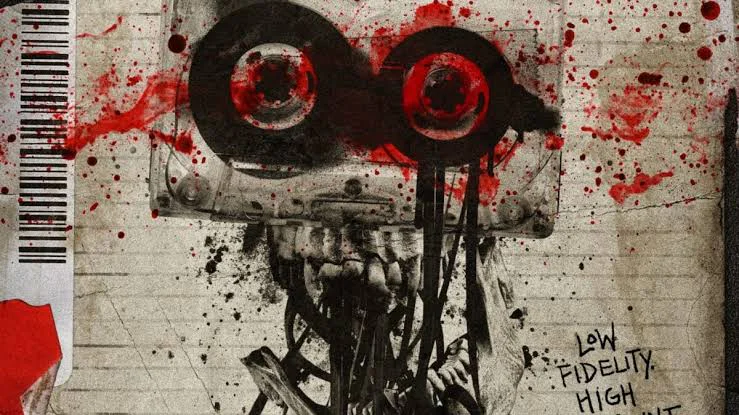

★★☆☆☆ – 2/5 Stars
The latest installment in Shudder’s long-running found-footage franchise brings together GWAR, RZA, Tobias Forge, and an eclectic collection of horror shorts. Unfortunately, V/H/S/Mixtape might be the clearest indication yet that the series has lost sight of what made it work in the first place.

I’ve been a fan of the V/H/S/ franchise for a long time. Anthology horror has always been a mixed bag by its very nature, and I’ve been willing to forgive more than a few misfires along the way. Even the weaker installments have generally offered something worth watching, whether it was a particularly inventive premise, an unexpected scare, or a filmmaker finding a clever new way to exploit the found-footage format.
Which makes V/H/S/Mixtape all the more disappointing.
This isn’t just a collection of shorts that don’t quite land. It’s a movie that seems fundamentally confused about what it wants to be.
And for a franchise built around such a recognizable concept, that’s a much bigger problem.
GWAR Is Great. GWAR in V/H/S/? Not So Much.
Let’s start with GWAR.
I like GWAR. I appreciate the band’s outrageous theatricality, grotesque costumes, over-the-top performances, and unapologetically ridiculous sense of humor. They’re funny in their own right, and their entire existence feels like something that should naturally complement the horror genre.
But that doesn’t necessarily mean they’re a good fit for V/H/S/.
The GWAR wraparound segments feel forced almost immediately. The humor, which should be one of the band’s greatest assets, falls surprisingly flat, and the repeated appearances quickly become more exhausting than entertaining.
It’s almost a case of too much of a good thing.
What works during a GWAR concert or in the band’s own bizarre universe doesn’t automatically translate into an anthology horror movie. Here, the material feels like it’s trying a little too hard to be outrageous, and the result is a series of interruptions that rarely add anything meaningful to the experience.
Ironically, GWAR repeatedly references the concept of found footage, even dedicating part of the wraparound material to the term itself.
Which brings us to the biggest problem with Mixtape.
Is This Even Found Footage Anymore?
At what point does a found-footage franchise stop being a found-footage franchise?
Because V/H/S/Mixtape seems determined to find out.
The original appeal of V/H/S/ was its commitment to presenting horror through supposedly discovered recordings. The shaky cameras, imperfect framing, rough audio, and limited perspectives weren’t just aesthetic choices. They were fundamental to the experience.
They made the horror feel immediate, unpredictable, and occasionally uncomfortably real.
Mixtape, on the other hand, feels like an anthology of unrelated horror experiments that have been squeezed into the V/H/S/ brand.
Some segments are overtly cinematic. One is essentially a music video. Another is animated. Others attempt more traditional found-footage storytelling but struggle to justify their place in the collection beyond simply featuring a camera.
There’s nothing inherently wrong with experimentation. In fact, the franchise desperately needs fresh ideas.
But experimentation and abandoning your identity are two very different things.
The problem isn’t that Mixtape tries something new. It’s that it rarely makes those new approaches feel like they belong together.
RZA Delivers Beautiful Images and Painfully Bad Acting
RZA’s contribution, Death Tone, might be the most frustrating segment of the entire collection.
Visually, it’s gorgeous.
The cinematography is polished, the compositions are deliberate, and there’s a genuine cinematic quality to the production that immediately separates it from much of the material surrounding it.
Unfortunately, that polish becomes part of the problem.
For starters, it barely feels like found footage. The segment makes an effort to squeeze itself into the format, but the presentation is so overtly cinematic that the conceit never feels particularly convincing.
Worse still, the acting is painfully bad.
And I mean painfully bad.
There’s an enormous disconnect between the visual craftsmanship and the performances. What should be one of the anthology’s standout contributions instead becomes a frustrating exercise in watching strong production values undermined by dialogue delivery and performances that simply don’t work.
It’s a shame, because the filmmaking talent is clearly visible.
But beautiful cinematography can’t rescue a story when the people inhabiting it fail to make the material believable.
Tobias Forge Offers One of the Better Ideas, Buried Inside a Music Video
Tobias Forge, best known as the creative force behind Ghost, takes a different approach with a segment built around music from Repugnant.
I’ll admit right away that I’m not particularly a fan of Repugnant’s music.
And that’s a fairly significant obstacle when you’re asking an audience to sit through a horror short that functions largely as a music video.
If the music doesn’t appeal to you, there’s a good chance the segment itself won’t either.
Which is unfortunate, because buried beneath the musical presentation is one of Mixtape‘s more interesting creative ideas.
There’s something wonderfully old-fashioned about its storytelling. Strip away the music-video framework, and the segment feels like a self-contained episode of The Twilight Zone, Alfred Hitchcock Presents, or even Night Gallery.
It has that same compact, macabre sensibility: a strange premise, an unsettling progression, and the feeling that you’re watching a miniature morality tale with a sinister edge.
And I genuinely liked that aspect of it.
Forge clearly has some storytelling instincts worth exploring, and I’d be interested in seeing what he could accomplish with a more traditional horror short.
But again, we’re left with the same question.
What does this have to do with V/H/S/?
The segment might have been more effective standing entirely on its own.
Even the Traditional Found-Footage Segments Struggle
You might think that the more conventional found-footage contributions would help anchor the anthology.
Unfortunately, they don’t fare much better.
One segment, Dance, Dance, Dance, Dance, involving puppets, becomes almost immediately predictable. Once the premise is established, there’s very little mystery about where things are headed, and the repetition drains whatever tension the concept initially generates.
Another, Heartbeat, follows a couple trapped in a facility associated with sensory-deprivation experiments.
On paper, that’s a genuinely terrifying setup.
The idea of being trapped somewhere that strips away your ability to understand your surroundings, leaving you vulnerable to whatever might be lurking nearby, has tremendous horror potential.
But the execution becomes repetitive far too quickly.
Instead of steadily escalating the terror or finding new ways to exploit the premise, the segment keeps returning to the same ideas until the initial sense of dread gives way to boredom.
And then there’s the animated contribution, which only reinforces the anthology’s identity problem.
Animation can absolutely be terrifying. Some of the most imaginative horror storytelling ever produced has come from the medium.
But within a franchise supposedly built around discovered video recordings, its inclusion feels less like a natural evolution and more like another example of Mixtape throwing ideas at the wall to see what sticks.
Has V/H/S/ Finally Run Out of Tape?
This is the part that genuinely disappoints me.
I look forward to every new V/H/S/ installment.
Even when a particular movie hasn’t completely worked, I’ve usually found enough creative energy, clever concepts, or memorable imagery to justify the experience.
There’s something exciting about the anthology format when it’s done well. You never know what the next segment might bring, and the possibility of discovering an unexpected gem is part of the appeal.
But V/H/S/Mixtape might be the first installment that left me wondering whether the franchise has simply exhausted its current creative direction.
It doesn’t need bigger names.
It doesn’t need more gimmicks.
And it certainly doesn’t need to keep reminding us that we’re supposedly watching found footage while presenting material that feels increasingly removed from that concept.
What it needs is a renewed creative vision.
Bring in new writers. Find filmmakers with something genuinely interesting to say about the format. Revisit what made the original concept compelling without simply recycling the same tricks.
Most importantly, give the franchise a reason to exist beyond the fact that audiences recognize the name.
Because right now, V/H/S/ feels less like an evolving horror series and more like a brand desperately searching for its next identity.
And that’s a scary place for any franchise to find itself.
V/H/S/Mixtape Review – Final Verdict: 2/5 Stars
★★☆☆☆
V/H/S/Mixtape isn’t completely without merit. RZA’s segment offers impressive cinematography, Tobias Forge demonstrates an intriguing talent for compact horror storytelling, and a few scattered ideas suggest that there’s still creative potential buried somewhere within the franchise.
But those moments aren’t enough to overcome the weak performances, repetitive storytelling, awkward GWAR wraparounds, and an increasingly muddled relationship with the found-footage format.
For a series I’ve genuinely enjoyed following, this is a particularly frustrating disappointment.
Two out of five stars.
Maybe it’s time to stop recording, rewind the tape, and remember why we started watching in the first place.
More V/H/S/ on Horror-Fix: Before diving into the latest installment, check out our ranking of the V/H/S/ movies and see where your favorites land.
